Wednesday, July 11, 2012

Buying Flowers For Her

By Rachel Newcombe 

Most women love recieving flowers from the man in their life, especially when they come as a surprise and no subtle hints have been dropped beforehand. But have you ever stopped to consider what his choice of floral gift could signify? Read on to discover the secret language of flowers.
 

Roses

 
Whether it’s a single stem or a dozen blooms, roses have a long-standing tradition as the flowers to buy on St. Valentine’s Day. “To many people red roses symbolise passion, romance and true love,” said a spokesperson for the Flowers and Plants Association (FPA). “Yet, some people think they also symbolise a lack of originality!” 


If you’ve received roses other than red, a mix of red and white flowers is said to represent unity, white on their own signify charm and innocence, pinks mean happiness and yellows were traditionally given to friends.
 

Carnations

 
Carnations are one of the best-selling forms of cut flowers and, although disregarded as lacking style in the past, are now thought of in a better light. “The botanical name of carnations, Dianthus, means divine flower, and they’re available in a huge range of colours, almost all except blue,” explained the FPA.


According to tradition, what’s meant when you receive carnations depends on the colour of the flower. A deep red shade means, “I admire you,” and a shade of pink means, “I’ll never forget you.” Receiving a yellow flower isn’t quite so great, as it’s traditionally associated as being a form of rejection!
 

Chrysanthemums

 
These days chrysanthemum’s come in a host of colours, shapes and sizes. They’re bright and stylish, and a favourite of Madonna’s, and are popular bunched together on their own or in a bouquet of mixed flowers.


Traditionally, a mixed bunch of chrysanthemum’s is thought to reflect cheerfulness and friendship, but red chrysanthemum’s can be used to say, “I love you.”
 

Lilies

 
Stunning Lilies with their heady scent look gorgeous on their own or in a mixed arrangement. Historically, pure white lilies were regarded as being a symbol of purity and the Chinese see them as representing being forever in love. 


Orchids

 
Exotic orchids, with their unique look, traditionally represent love, beauty and refinement, so are perfect flower to receive from a lover. Whether you’re given a single orchid or an arrangement of several, it can mean your man has looked beyond the ordinary and found something special for you. 


Ranunculus

 
These delicate tissue-like flowers are part of the buttercup family, but when fully opened up, look similar to roses. They come in a variety of colours, including red, pink, orange, white, yellow and copper, and have stunning dark or yellow centres. 


“The Victorians believed the flowers meant, ‘you are rich in attractions,’” says the FPA, so receiving a bunch of these could mean that a certain someone finds you attractive. 
 

Freesias

 
Freesias rank amongst the world's favourite flowers and are well-loved for their sweet floral scent and array of rainbow colours. Named after a German physician, Dr. Friedrich Heinrich Theodor Freese, the delicate flowers mean ‘sweetness’ and ‘trust.’ So, he could be letting you know he loves and trusts you.


Tulips
 
With their fresh, bright colours, tulips are the flowers many people typically associate with spring. But they have other hidden meanings, too. “According to the Victorian language of flowers, red tulips are a declaration of love, making them perfect for Valentine’s Day,” say the FPA. 


So, next time he sends you flowers, take a moment to observe the blooms. You never know, you could get a pleasant surprise!


Top tips for buying flowers – and making better choices

 
* Before you buy the first bunch of flowers you see, find out what flowers or colours your partner likes and choose flowers appropriately.
 
* Don’t get carried away – sometimes a single stem or small bouquet is just as great as a huge arrangement.
 
* Be original – look past red roses and find something perfect for your partner.
 
* Finally, don’t be embarrassed about buying flowers. According to research from the FPA, women are impressed with guys who buy flowers and see them as caring, generous and sensitive – which is surely an aspect that makes it even more worthwhile!

Tuesday, July 10, 2012

The Great History Of Roses

“It was roses, roses all the way.”
- Robert Browning

“What's in a name? That which we call a rose; By any other name would smell as sweet.”
- William Shakespeare, Romeo and Juliet, Act 2 scene 2

Roses have a long and colorful history. According to fossil evidence, the rose is 35 million years old. Today, there are over 30,000 varieties of roses and it has the most complicated family tree of any known flower species.

The cultivation of roses most likely began in Asia around 5000 years ago. They have been part of the human experience ever since and mentions of the flower are woven into a great many tales from the ancient world.

And there are so many beautiful stories that include roses through out the ages that we all can recognize. 


Greek mythology tells us that it was Aphrodite who gave the rose its name, but it was the goddess of flowers, Chloris, who created it. One day while Chloris was cleaning in the forest she found the lifeless body of a beautiful nymph. To right this wrong Chloris enlisted the help of Aphrodite, the goddess of love, who gave her beauty; then called upon Dionysus, the god of wine, who added nectar to give her a sweet scent. When it was their turn the three Graces gave Chloris charm, brightness and joy. Then Zephyr, the West Wind, blew away the clouds so that Apollo, the sun god, could shine and make the flower bloom. And so the Rose was...

In another story, an ancient Hindu legend, Brahma (the creator of the world) and Vishnu (the protector of the world) argued over whether the lotus was more beautiful than the rose. Vishnu backed the rose, while Brahma supported the lotus. But Brahma had never seen a rose before and when he did he immediately recanted. As a reward Brahma created a bride for Vishnu and called her Lakshmi — she was created from 108 large and 1008 small rose petals.

Several thousands of years later, on the other side of the world in Crete , there are Frescoes which date to c. 1700BC illustrating a rose with five-pedaled pink blooms. Discoveries of tombs in Egypt have revealed wreaths made with flowers, with roses among them. The wreath in the tomb of Hawara (discovered by the English archaeologist William Flinders Petrie) dates to about AD 170, and represents the oldest preserved record of a rose species still living. 


Roses later became synonymous with the worst excesses of the Roman Empire when the peasants were reduced to growing roses instead of food crops in order to satisfy the demands of their rulers. The emperors filled their swimming baths and fountains with rose-water and sat on carpets of rose petals for their feasts and orgies. Roses were used as confetti at celebrations, for medicinal purposes, and as a source of perfume. Heliogabalus used to enjoy showering his guests with rose petals which tumbled down from the ceiling during the festivities.

During the fifteenth century, the factions fighting to control England used the rose as a symbol. The white rose represented York , and the red rose symbolized Lancaster . Not surprisingly, the conflict between these factions became known as the War of the Roses.

In the seventeenth century roses were in such high demand that roses and rose water were considered as legal tender. In this capacity they were used as barter in the markets as well as for any payments the common people had to make to royalty. Napoleon's wife Josephine loved roses so much she established an extensive collection at Chateau de Malmaison, an estate seven miles west of Paris . This garden of more than 250 rose varieties became the setting for Pierre Joseph Redoute's work as a botanical illustrator and it was here Redoute completed his watercolor collection "Les Rose," which is still considered one of the finest records of botanical illustration.


Cultivated roses weren’t introduced into Europe until the late eighteenth century. These introductions came from China and were repeat bloomers, making them of great interest to hybridizers who no longer had to wait once a year for their roses to bloom.

From this introduction, experts today tend to divide all roses into two groups. There are “old roses” (those cultivated in Europe before 1800) and “modern roses” (those which began to be cultivated in England and France around the turn of the 19th century).

Until the beginning of the 19th century, all roses in Europe were shades of pink or white. Our romantic symbol of the red rose first came from China around 1800. Unusual green roses arrived a few decades later.


Bright yellow roses entered the palette around 1900. It was the Frenchman Joseph Permet-Ducher who is credited with the discovery. After more than 20 years of breeding roses in a search for a hardy yellow variety, he luck changed when one day he simply stumbled across a mutant yellow flower in a field. We have had yellow and orange roses ever since.

The rose is a phenomenal plant and is rightly known as ‘the world’s favorite flower’. No other flower has ever experienced the same popularity that the rose has enjoyed in the last fifth years. In temperate climates, roses are more widely grown than any other ornamental plant, and as cut flowers they are forever in fashion.

It has been estimated that 150 million plants are purchased by gardeners worldwide every year, and sophisticated breeding programs have produced a plant that dominates the world’s cut flower market; the annual crop is calculated in tons. Roses have also made a tremendous contribution to the perfume industry.

Roses boast an ancient lineage, and they are intricately entwined in our history and culture. As a motif, the rose has been and still is depicted in many national emblems. It has been adopted by countless political factions, and even by businesses and several international events. It is no wonder so many of the beautiful rose varietals are greatly appreciated and cultivated by hobby gardeners around the world.


Saturday, July 7, 2012

Australia's Kangaroo Paws

One of the most unique florals, Australia's national flower the Kangaroo Paw has some very interesting facts to go along with that interesting name.


  • Native to Australia, Kangaroo Paws are exported to many parts of the globe and are grown commercially in the USA, Israel and Japan.
  • The size, flower-stalk height and colour of kangaroo paws flowers varies between the species.
  • The overall colour of the flowers is influenced by fine coloured hairs which cover the flowers and, sometimes, part of the stalk.


  •  The flowers appear over spring and summer. 
  • The flowers are pollinated by birds, unlike the majority of flower species that are polinated by insects. 
  • A major disease of kangaroo paws is a fungus which causes ink disease, Ink disease appears as large black blotches on the leaves.


  • In general kangaroo paws grow best in well-drained soils in a sunny position. Well-composted organic matter will improve growth.
  • The fuzzy Kangaroo Paw flowers can irritate the skin and should be avoided by persons with floral allergies.
  • The genus name, Anigozanthos is derived from the Greek word 'anises', meaning unequal or oblique, and 'anthos', meaning flower, an allusion to the division of the Kangaroo Paw flower into six unequal parts.

Thursday, July 5, 2012

Raising Happy And Healthy Houseplants

Raising houseplants is a great way to bring the beauty of nature into your home, and a great way to enjoy your gardening hobby even when the snow is falling.  Raising healthy houseplants can be a challenge for the inexperienced gardener, but following these simple tips can help you get off on the right foot.
 
Let’s start out with what you should do to keep those houseplants happy and healthy.  Then we’ll move on to a list of things to avoid.

Keep the labels that came with the plants you purchased.  Those plant labels provide a wealth of information, including proper humidity and pH levels, watering advice and more.  Unfortunately many gardeners toss that valuable information right into the trash once the are home from the nursery.

  
  • Use distilled water whenever possible.  Tap water can contain pollutants and other impurities that could damage your houseplants.  When watering plants with distilled water make sure the water is room temperature.  Watering plants with cold water can shock them and cause them to wilt.
  • Stick with natural pesticides.  This is particularly important if you have kids and pets in the household – many chemical pesticides can leave harmful residues that children or pets could ingest.  There are plenty of natural solutions to pest problems, including ordinary dishwashing liquid, hot peppers and alcohol.
  • Make sure your houseplants are pet friendly.  Many plants can be harmful, or even fatal, to cats and dogs.  If you are unsure if your houseplants are safe be sure to consult your veterinarian.


Now let’s take a look at some of the most common mistakes houseplant owners make.  If you want to enjoy a house full of healthy houseplants, don’t:
 
  • Do not over water your plants. This is perhaps the most common mistake beginning gardeners make.  Most plants can withstand a lack of moisture much better than too much water.  Instead of watering the plants on a set schedule, give them water only when the soil is no longer moist.
  • Don’t turn off the lights.  Unlike outdoor plants, houseplants cannot rely on abundant sunshine for the light they need.  Be sure to leave some lights on or place the plants near a sunny window.
  • Don’t expose your plants to heat sources.  Pay attention to where you put those plants.  Placing houseplants near heat sources can damage them and cause them to dry out.
  • Don’t forget about pest control.  Plant pests can and do come indoors, so be sure to use proper pest control.  Neglecting the possibility of pests can leave your houseplants struggling to survive.
  •  Don’t allow your plants to outgrow their pots.  Many houseplants can grow quite quickly, and that high growth rate can cause them to get too big for their current home.  Allowing your plants to outgrow their containers could cause root damage and other serious issues.
  Paying attention to these tips can help your houseplants grow healthy and strong and help you become a highly successful indoor gardener.  Bringing those beautiful plants into the home is a great way to enjoy the beauty of nature year round.  The key is to pay attention to the needs of those plants and give them what they need to grow healthy and strong.

Wednesday, July 4, 2012

Fun Facts About Birds Of Paradise

 Amazing Facts about the Bird of Paradise Plant


  • The scientific name of this plant is Strelitzia, pronounced STRE-lit-see-a.
  • The plant was named for Queen Charlotte, wife of King George III. She was of the House of Mecklenburg – Strelitzia.
  • The Bird of Paradise, as it is commonly known, is a tropical herb. It has large oval leaves on long stems. The flowers of the plant are blue and orange and resemble an exotic bird in flight.


  • Bird of Paradise originated in South Africa.
  • It belongs to the banana family.
  • Bird of Paradise blooms from September to the end of May.


  • The long blue tongue is the female part of the flower.
  • Bird of Paradise will thrive in most soils, but fertile loam is best. Soil must be well drained. Over watering will cause root rot.
  • The most flowers are produced along the plant’s periphery. 


  • It takes 3 to 5 years to grow a Bird of Paradise plant from seed.
  • Seeds must be soaked in water and nicked in order to germinate because the shell of the seed is extremely hard.
  • Bird of Paradise plants are usually pest free. Check for aphids on occasion.  
  • Though Bird of Paradise is a tropical plant, it can withstand temperatures as low as 24 degrees Fahrenheit, though flowers and buds will be damaged.
  • Bird of Paradise is grown commercially in California and Hawaii.

By Mary M. Alward


Tuesday, July 3, 2012

Summer Wedding Favors

You are getting married this Summer. Maybe you're traditional. Maybe you just enjoy the greater convenience of a summer wedding. Or, perhaps you chose the date because it represents something personal. Whatever the reason, planning a summer wedding gives you thousands of choices. That extends to summer wedding favors that will delight your guests.

The variety of activities enjoyed during Summer opens up an array of themes to incorporate into a summer wedding favor.

Summer flowers are a delight at any wedding. Continuing that look to decorate the table and provide a small gift for guests is a great idea. Small flower holders, perhaps personalized with the bride and groom's names and the date is one way to do so. Fill the little vase with silk summer roses and you've got a hit.


Imagine sailing over the lake near your honeymoon cottage. Use that image in your summer wedding favors. A small glass sailboat with a logo that evokes a wedding can be the perfect choice. Add to the scene with some small, colorful beach balls and you've got a 'mini movie' worthy of your wedding.

Keep that ball rolling by pairing it with some delightful handcrafted starfish and clams. Decorate the table with a tiny marble sand crab and you'll give your guests a gift they'll remember long after the special day.


Maybe you're heading out to a tropical island for your honeymoon vacation. Perfect. Sea breezes, water sports, lazing in the sun. Provide your guests with miniature reminders of the joy to come. A tiny golf bag and clubs will amuse many. Or, select some pineapple-themed name card holders. Toss into the little sandbox some flip flop leather keychains in Hawaiian colors.


Everyone likes photo frames. Fill them with a picture of the bride and groom the day they got engaged. Complete the setting with a sea shell lining around the rim.  Add a miniature surfboard of the type the happy couple shared on that happy day. Or, opt for a miniature copy of the bucket they used to build a sandcastle. Here, those could be in the form of a candle holder.


Maybe the forest is more your style of outdoor atmosphere. You may be planning to stay in a Bed and Breakfast in the Black Forest of Germany or the mountains of Montana. Reflect that in your summer wedding favors.

Mini-lanterns that hold a bulb or candle can light your guests' way to the table. Provide miniature pine trees or redwoods with little cabins at the base for your guests' wedding favors. Or, give tiny ceramic horses of the type you and your future spouse will ride during that dream vacation trip. They'll delight in taking them home as a memento of your wedding day.


The possibilities are endless. But no matter which summer wedding favors you choose you can't go wrong. Every guest will be happy with the summer wedding favor you select because it will remind them of the joy they shared with you that special day.

Monday, July 2, 2012

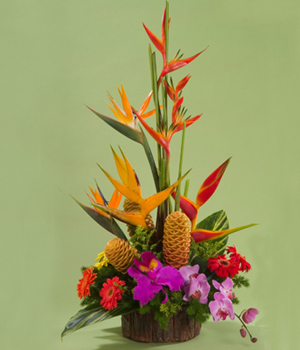
Care For Fresh Cut Tropicals

Tropical flower arrangements add life to your office or home. Tropical flowers are generally much hardier than their softer cousins. They are brilliantly colored and have a longer shelf life especially if you care for them properly.


Here are some things you can do to maximize their life:

1) Every type of fresh cut flower will produce a certain amount of ethylene gas during shipping but this can be taken care of by immediately unwrapping them and submersing them completely in a room temperature bath or large tub of water for 10 to 20 minutes. This applies to almost all the tropicals except for the fuzzy protease and most orchids.

2) Cut the stem of your tropicals about an inch from the bottom at about a 45-degree angle. The slant ensures that the stem will draw the maximum amount of water. Do this several times during the week and you will extend their life.

3) Tropicals grow in warm rainy climates and they enjoy being wet. For this reason keep your tropicals away from drafts and cool places and direct sunlight. Spray mist them daily to keep the moisture content up. In nature tropical blooms have pods facing upward, as they like to pool water in them. You can also do this with your fresh cuts.


4) If you find that the water gets cloudy then put a few drops of bleach in the water. This helps to prevent bacteria from growing and this will not hurt the flowers.

5) Make sure that when you design your flowers in a vase that you do not have any greens below the water line. This will rapidly decay the rest of the arrangement.

6) If you have purchased bird of paradise for your arrangement and they are not open, you can gently ease them apart by taking your index finger or thumb and slowly push your way at the base of the flower and force the blooms up.


Most tropicals will last between 7 to 14 days if properly taken care of. We have seen cymbidium orchids last as long as 3 weeks. So enjoy these vibrant exotic flowers in your home or office!